Spider & Silk Supply
Silk Pathways to Nerve Healing


Our
Project
Vision and Mission
Peripheral nerve injuries, though relatively rare, pose significant challenges due to the nature of the resulting disabilities and high socio-economic costs. Autologous nerve grafts are currently the gold standard for treatment; however, their use is constrained by donor site morbidity, limited availability, and insufficient length for repairing extensive nerve gaps. Artificial conduits offer a promising alternative, yet their application is currently restricted to defects under 6 cm. To overcome these limitations, spider silk has been touted as a material with excellent potential for applications for nerve regeneration.
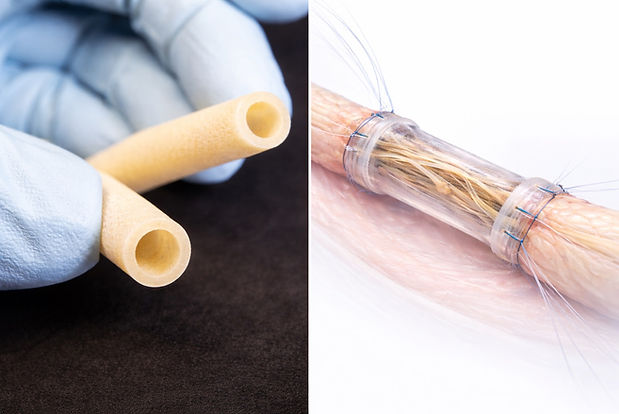
Spider silk’s unique properties, high tensile strength, elasticity, biocompatibility, slow enzymatic degradation, while remaining lightweight—make it an ideal candidate for many biomedical applications. Silk fibres not only facilitate axonal regrowth but also provide a scaffold for Schwann cell migration and proliferation, crucial for nerve regeneration. A few recent studies have successfully created spider silk-based conduit archetypes capable of bridging nerve gaps of up to 20 cm in animal models, including rats and sheep.
Native spider silk, or the silk taken directly from spider spinnerets, has superior functionality as a nerve conduit compared to recombinant spider silk. This is because its molecular structure and spinning process have been optimized to give it unmatched tensile strength, elasticity, and surface properties that help cells stick to it and move around. Additionally, native silk’s intricate hierarchical architecture and natural hydrophilicity closely mimic an extracellular matrix, enhancing its biocompatibility and integration with nerve tissue without inducing immune or other unwanted physiological responses. One serious issue with using native spider silks, however, is that attaining large quantities currently seems elusive.